
news
Why Choose Cut Resistant Apron China for Industrial Safety
Quick Answer: Sourcing a cut resistant apron in China makes commercial sense when the supplier can show a certified cut level, consistent HPPE or aramid construction, and a documented sampling procedure. The decision should rest on three questions: which standard the apron is rated to, whether the test report can be traced to the actual model, and whether the supplier can hold that specification across repeat batches. Price differences between suppliers usually track those three answers rather than the material cost.
In this guide
- What a cut resistant apron actually protects against
- The features that separate industrial grade from retail grade
- Certification, test reports and how to read them
- Applications in automotive and food processing
- Sourcing, lead times and what to confirm before ordering
What a Cut Resistant Apron Is For
A cut resistant apron is body protection for the torso and upper legs, worn where the hands are already covered but the body is still exposed to a blade, a sharp edge or a moving cutting line. It sits alongside gloves and sleeves in a layered PPE system, and its job is to prevent the lacerations that happen when material slips, when a blade is carried at waist height, or when a worker pulls stock towards themselves along a cutting table.
Why Cut Resistant Aprons Are Sourced from China
Global buyers have moved towards Chinese apron manufacturers for three structural reasons. First, HPPE and aramid fibre supply sits close to the manufacturing base, so the material cost of a certified apron is competitive rather than discounted. Second, the factories that make cut-resistant clothing usually make gloves and sleeves on the same lines, so a buyer can build a coherent layered PPE programme from one supplier instead of matching fabrics from three. Third, customisation and OEM labelling are routine rather than a special project.
Choosing a cut resistant apron in China therefore is not mainly a price decision. It is a decision about whether the supplier can hold a specification, document it and repeat it.
Key Features That Separate Industrial Grade from Retail Grade
Cut level and the standard behind it
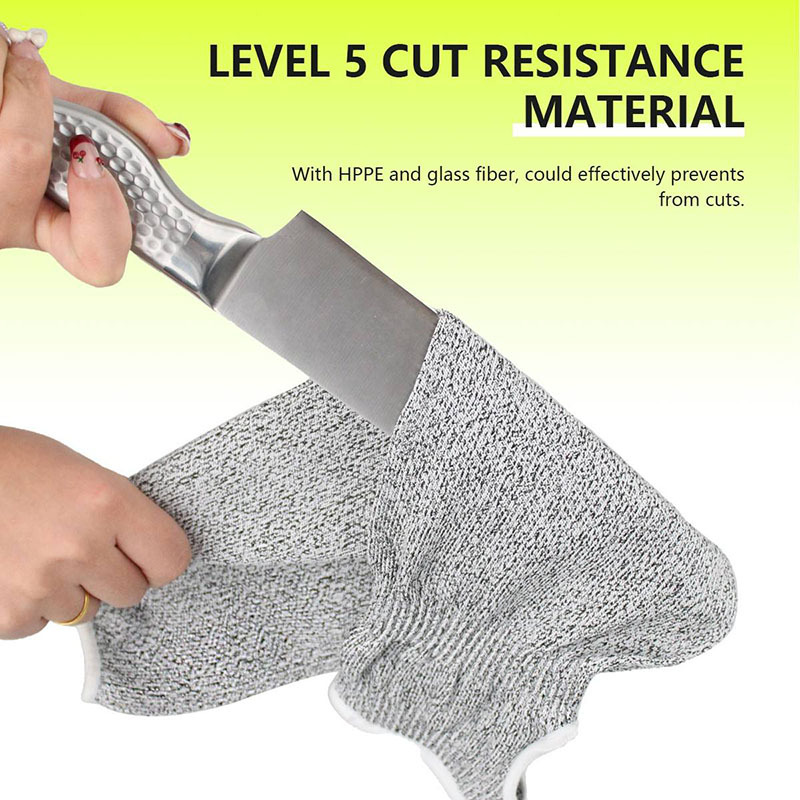
Every apron carries a cut claim, and the claim is only meaningful with the standard attached. The American system grades cut resistance from A1 to A9 on a straight-blade test, with published gram thresholds for each level (ANSI/ISEA 105-2024 cut level ratings). The European system grades mechanical risk from level A to F under EN 388. The two scales are not interchangeable, so a specification quoting a level without naming the standard cannot be compared with a competing quote.
Materials and construction
HPPE gives a high cut rating for its weight and stays flexible enough for all-day wear, which is why it dominates the middle of the range. Aramid blends tolerate heat alongside cutting, making them the choice where sparks or hot contact are present. Stainless steel mesh offers the highest resistance to severe blade exposure but is heavier and less comfortable for continuous wear. The right answer is determined by the hazard, not by the highest available number.
Wearability and cleaning
An apron that is uncomfortable will not be worn, and an apron that cannot be cleaned will not pass hygiene inspection. Look for an adjustable neck strap and waist ties that fit across a range of body sizes, seams that do not dig in at the shoulders, and a construction the site can wash in line with its own protocols — machine-washable options remove a recurring cost from food and pharmaceutical environments. For a closer look at washable construction, see easy-clean machine-washable cut resistant aprons and, where chemicals are also present, EN 388 certified chemical-resistant cut-resistant aprons.
Certification and Test Reports
Cut claims should be treated as verifiable statements rather than marketing. A supplier should be able to supply a test report from an accredited laboratory that names the exact apron model, the standard applied and the measured result. Where the claim covers more than one hazard, there should be more than one report, because cut resistance, puncture resistance and chemical permeation are measured by different methods.
At the factory level, quality management and traceability matter as much as the glove itself: documented sampling of production runs, retained samples, and the ability to trace a delivered batch back to its materials. Buyers should ask how often the model is retested and what happens when a batch falls outside tolerance, because that answer describes the process rather than a single result.
Applications and Real-World Performance
The two sectors that drive most apron sourcing are automotive and food processing, and they stress different properties.
- Automotive assembly and metal fabrication — handling stamped panels, trim and sharp metal along a moving line. The pain point is a torso laceration when a panel slips during transfer; an apron rated to the cut exposure of the task, worn over gloves and sleeves of the same construction, closes the gap between hand and body protection.
- Food processing and butchery — boning, portioning and cutting on stainless tables with repeated passes of a knife. The pain point is a knife slipping towards the torso, and a second pain point is hygiene; the apron has to be cut resistant and washable under the plant's own cleaning regime.
- Glass handling — moving sheets and offcuts where edges are sharp. The pain point is lean-in contact across the abdomen during a manual lift; full-coverage aprons reduce the exposed area without restricting movement.
- Warehousing and recycling sorting — mixed sharp waste and cut strapping. The pain point is unpredictable exposure levels through a shift; a single middle-band apron covering the common hazards is more likely to be worn than several task-specific ones.
- Maintenance and blade change work — replacing slitter or machine blades, where blades are carried and manoeuvred by hand. The pain point is body contact during a two-handed task; an apron adds a layer exactly where the blade path can end up.
Related equipment: the wider body protection range covers aprons, sleeves and clothing built for the same hazards.
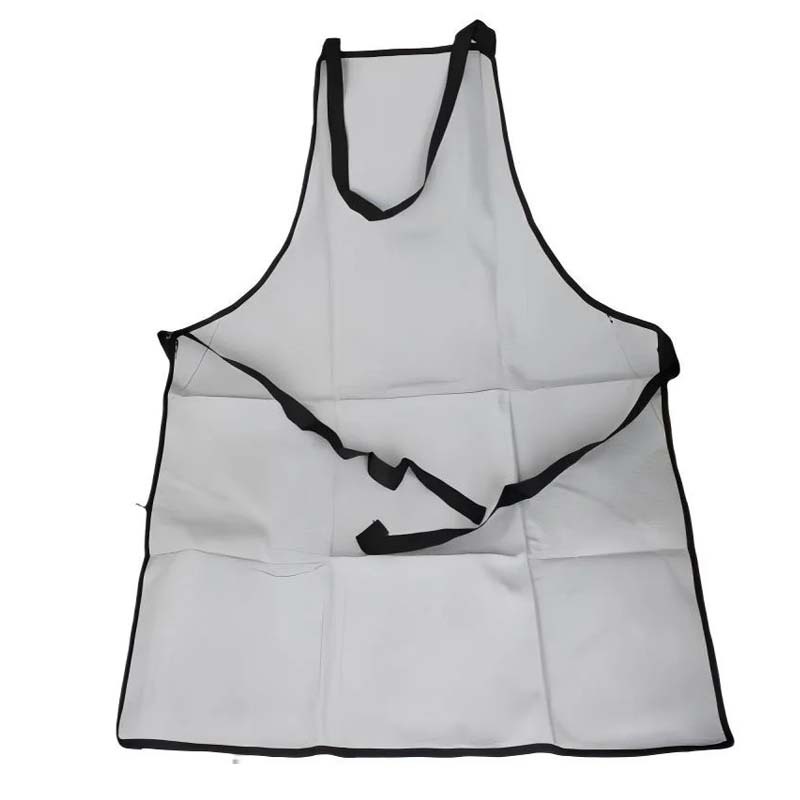
S2017 Anti-cut Apron
- Cut-resistant body protection for cutting and fabrication work
- Adjustable fit with a construction suited to site cleaning regimes
- OEM colour, logo and sizing available
Procurement: What to Confirm Before Ordering
Reliable sourcing is decided by the questions asked before the purchase order, not after the first shipment. The list below is the minimum a buyer should have in writing.
- Standard and level: name the standard and the level the apron must meet, and confirm which test method produced it.
- Material and weight: specify HPPE, aramid or steel mesh, and the fabric weight, because the same cut level can be reached at different weights with different wear characteristics.
- Size range and adjustment: confirm the strap system and the body sizes covered, since a poor fit is the most common reason aprons are removed.
- Cleaning regime: state the maximum wash temperature and whether the site uses chemical sanitisers, so the construction can be matched to the process.
- MOQ, samples and lead time: ask for a pre-production sample in the final construction, the minimum order quantity and the production lead time, and confirm these in writing.
- Documentation: request the test report, the material certificate and the labelling specification that will ship with the goods.
Frequently Asked Questions
Which cut level should we specify for an apron?
Start from the task, not the catalogue. Where the exposure is a knife slipping on a cutting table, the middle bands cover most food production work; where blades are carried by hand or heavy sharp metal is transferred, the higher bands are justified. Specifying the highest available level instead of the correct level normally reduces wear rates, and an apron left on a hook protects nobody.
How do we confirm that an apron meets the cut level claimed?
Ask for a test report from an accredited laboratory that names the exact apron model and the standard applied, then verify that report with the issuing laboratory. A claim without a traceable report is an unverified claim, and the specification should say so before the order is placed.
Can aprons be customised for our brand and our site requirements?
Yes. Colour, logo, size range, strap configuration, fabric weight and packaging can all be specified, and OEM labelling is routine. Confirm the hazard assessment and the cleaning regime first, because those two inputs constrain the construction more than branding does.
Related reading: our guide to why certification matters when choosing a safety work gloves supplier, and Kevlar-lined gloves rated for EN 388 level 5 cut protection for users building a matching hand-protection specification.
0users like this.
