news
How to Choose Cut-Resistant Work Gloves: A Complete Buyer Guide
Quick Answer: Cut-resistant work gloves are rated by two different scales that are not interchangeable: EN388 uses A to F, and ANSI/ISEA 105 uses A1 to A9. A4 on one scale does not mean A4 on the other, so the first thing to confirm on any quote is which standard it refers to. After that, match the level to the hazard - A2 to A4 for general handling, A4 to A6 for sheet metal and blade work, A6 and above for heavy cutting - then choose the material, coating and gauge that suit the task. Buy for fit before features, because a glove that does not fit gets taken off, and a glove that is not worn protects nothing.
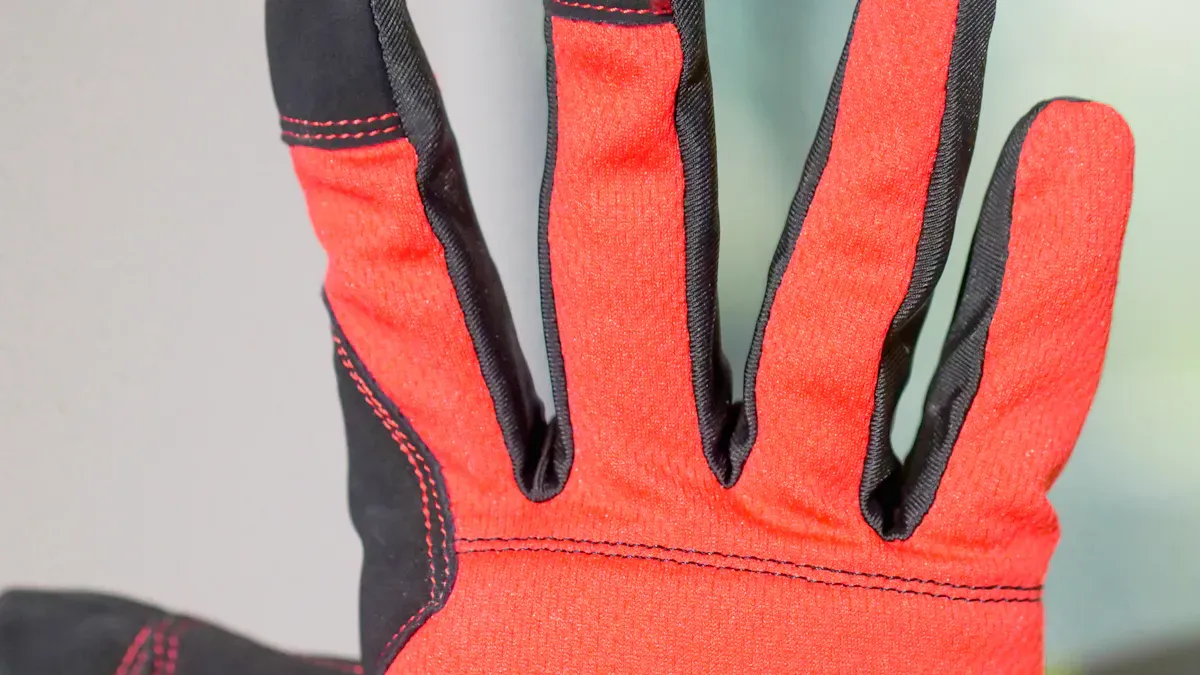
Most cut-resistant glove purchases go wrong in the same place: the buyer picks a number off a quote without knowing which standard it belongs to, or picks the highest number available because it sounds safer. Both habits lead to gloves that are either inadequate for the job or too stiff for workers to keep on.
This guide works the other way around. It explains what the two rating scales actually mean, what each material changes, and how to translate a specific hazard into a level and a specification. It closes with the checks worth making before you place an order.
Key Takeaways
- EN388 (A to F) and ANSI/ISEA 105 (A1 to A9) are different systems - the same letter or number means different things in each.
- Match the level to the hazard rather than buying the highest available rating; over-specifying costs dexterity and worker compliance.
- HPPE, para-aramid, and steel or glass fibre change the cut resistance, the weight and the cost - not all three move together.
- Coating choice affects grip and chemical resistance more than cut level; foam nitrile suits fine work, sandy nitrile suits oily environments.
- Always confirm the standard, the tested gauge and the certificate number on the quote before ordering.
Table of Contents
- What Cut-Resistant Gloves Are Rated For
- Materials and What They Actually Change
- Grip, Dexterity and Fit
- Breathability, Comfort and Durability
- Cut Level by Job Application
- Common Myths About Cut-Resistant Gloves
- What to Verify Before You Order
- Frequently Asked Questions
What Cut-Resistant Gloves Are Rated For
A cut-resistance rating tells you how the glove performed against a specific blade under a specific load, using a specific test procedure. It does not tell you how the glove will behave against a serrated edge, a hypodermic needle, or a moving saw blade. That distinction is where most specification mistakes start.
Two scales dominate global supply, and they are not convertible.
EN388: A to F
EN388 is the European mechanical-risk standard. It rates cut resistance with a circular blade under a fixed load, counting how many strokes the glove survives before the blade cuts through. The result is expressed as a letter from A to F:
| EN388 Cut Rating | What It Indicates | Typical Application |
|---|---|---|
| A | Minimal cut resistance | Light handling, packaging assembly |
| B | Low cut resistance | General warehouse, light parts handling |
| C | Moderate cut resistance | Light manufacturing, material handling |
| D | Good cut resistance | Sheet metal handling, light fabrication |
| E | High cut resistance | Blade work, stamping, glass handling |
| F | Excellent cut resistance | Heavy cutting, metal recycling, foundry |
EN388 also covers abrasion, tear, puncture and, in the 2016 revision, impact resistance. A full EN388 result therefore looks like a four- or five-digit code, not a single letter - for example 4543D, where the final letter is the cut rating. If a quote shows only one number, it is incomplete.
ANSI/ISEA 105: A1 to A9
ANSI/ISEA 105 is the North American standard. It uses a different blade, a different load range and a different number of test levels, and expresses the result as A1 through A9. The higher the number, the greater the cut load the glove withstood.
Because the two systems use different test procedures, there is no reliable conversion between them. The cut-resistant gloves range is normally specified against one system or the other, so confirm which one applies before comparing offers. A supplier who tells you EN388 A4 "equals" ANSI A4 is guessing. What you can do is compare performance within one system, and require that the quote names the system.
Why the Two Scales Differ in Practice
If you buy globally, you will meet both. The practical approach is to pick one system as your internal specification language, and require every supplier to quote in that system with a certificate number attached. Our breakdown of how cut-resistant gloves are tested covers the test procedure itself in more detail.
Materials and What They Actually Change
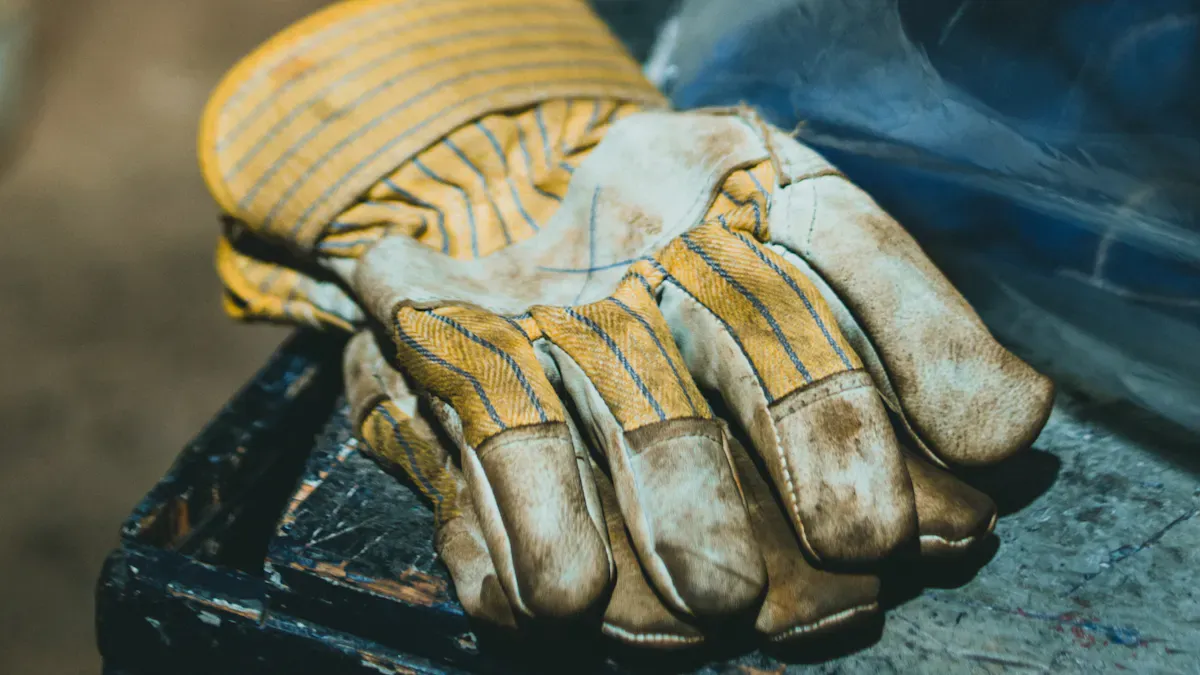
The liner material sets the cut resistance ceiling and the glove's weight. The coating sets grip and chemical resistance. The gauge - the number of stitches per inch in the knit - sets how thick and how dexterous the finished glove feels. These three choices interact, which is why a higher cut level almost always means a heavier, less dexterous glove.
HPPE
High-performance polyethylene is the most common liner in modern cut-resistant gloves. It is light, comfortable, and achieves good cut resistance at a reasonable gauge, which keeps dexterity high. It also resists moisture and most solvents, so it holds up in wet or oily environments better than natural fibres. For general manufacturing and assembly, HPPE is usually the right starting point. Our range of 13-gauge HPPE cut-resistant work gloves illustrates the trade-off - 13 gauge keeps the knit thin and the dexterity high.
Para-aramid
Para-aramid fibres, of which Kevlar is the best-known brand, offer high cut resistance and excellent heat resistance. They do not melt, which matters in welding, foundry and furnace work. The trade-offs are cost and UV degradation - para-aramid loses strength when exposed to sunlight over time, so gloves stored on a sunny ledge will degrade faster than the datasheet suggests. For applications combining heat and cut, para-aramid is often the only practical choice.
Steel and Glass Fibre
Stainless steel fibre and glass fibre are blended into the knit to raise cut resistance at lower gauge than HPPE alone can reach. Steel fibre is effective but heavier, and it can set off metal detectors, which rules it out for some food and electronics work. Glass fibre is lighter but more brittle, so it can break down with aggressive flexing. Both are usually blended with HPPE rather than used alone.
Coatings
The coating sits on the palm and fingers and does very little for cut resistance - it is there for grip and abrasion.
- Foam nitrile - light, flexible, good dry grip, best for fine assembly and inspection work.
- Sandy nitrile - heavier coating with a rougher surface, holds grip in oily and greasy conditions.
- Polyurethane - thin, light, good abrasion resistance and a clean feel, suited to precision handling where oil resistance is not needed.
- Latex - strong wet grip and good abrasion resistance, but a known allergy concern for some workers.
Grip, Dexterity and Fit

Grip and dexterity pull in opposite directions, and every specification choice trades one for the other. A heavier coating improves grip on wet metal and reduces dexterity on small components. A higher cut level requires more fibre or a heavier gauge, which reduces tactile feel.
For purchasing purposes, three things matter more than laboratory numbers:
- Can the worker feel the part? Have a worker perform the actual task wearing the sample glove. If they cannot feel a thin edge, the glove is too thick regardless of its rating.
- Does grip hold in the real environment? Test the coated palm with the oils and coolants actually present on the floor, not with a clean surface.
- Does the sizing run consistent? Order a sizing sample set before committing to a production run; knit gloves vary more between mills than most buyers expect.
Breathability, Comfort and Durability
Comfort is not a soft factor - it determines whether the glove stays on the hand. A glove that traps moisture gets removed, and an unworn glove offers no protection. The specifications that affect comfort in practice are gauge, coating coverage and cuff design.
Breathability comes mainly from the knit structure and the gauge. A 13-gauge or 15-gauge knit lets more vapour through than an 18-gauge shell, but the thicker knit is heavier. Partial coating - covering the palm and fingers but leaving the back open - improves airflow noticeably compared with a fully coated palm.
Durability depends on the application as much as the material. Abrasion and puncture resistance ratings indicate how long the protective layer survives against rough, high-friction materials. In practice, gloves used on rough sheet metal or recycled material wear through at the fingertips first, which is why some sites specify reinforced fingertips even when the base cut level would be sufficient.
For food processing and other wet environments, moisture retention is the main comfort problem. Maceration - skin softened by trapped moisture - leads to dermatitis and drives workers to remove gloves. Choosing a breathable knit with a thin coating, and replacing gloves on a schedule rather than on failure, addresses it more effectively than a higher cut rating does.
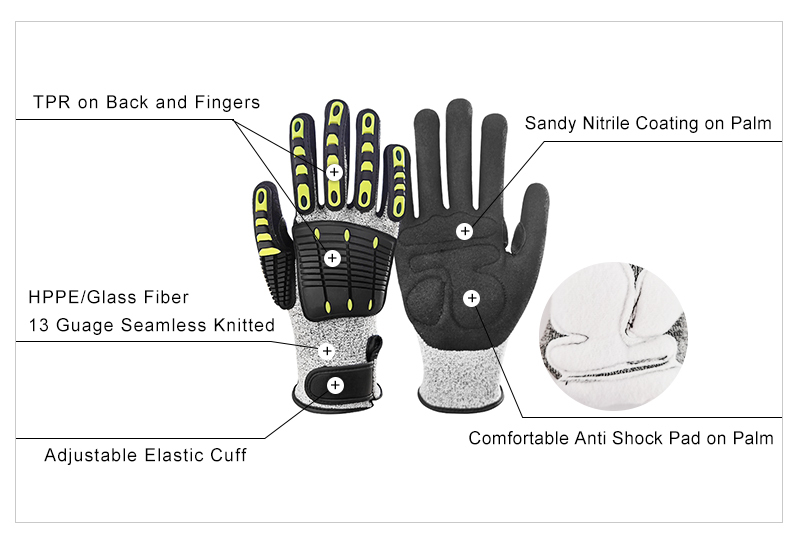
S1087T Level 5 Cut Resistant Impact Gloves
- 13-gauge HPPE and glass fibre shell with TPR on the back and fingers
- Sandy nitrile palm coating for grip in oily and wet conditions
- Adjustable elastic cuff with anti-shock palm padding for heavy handling
Cut Level by Job Application
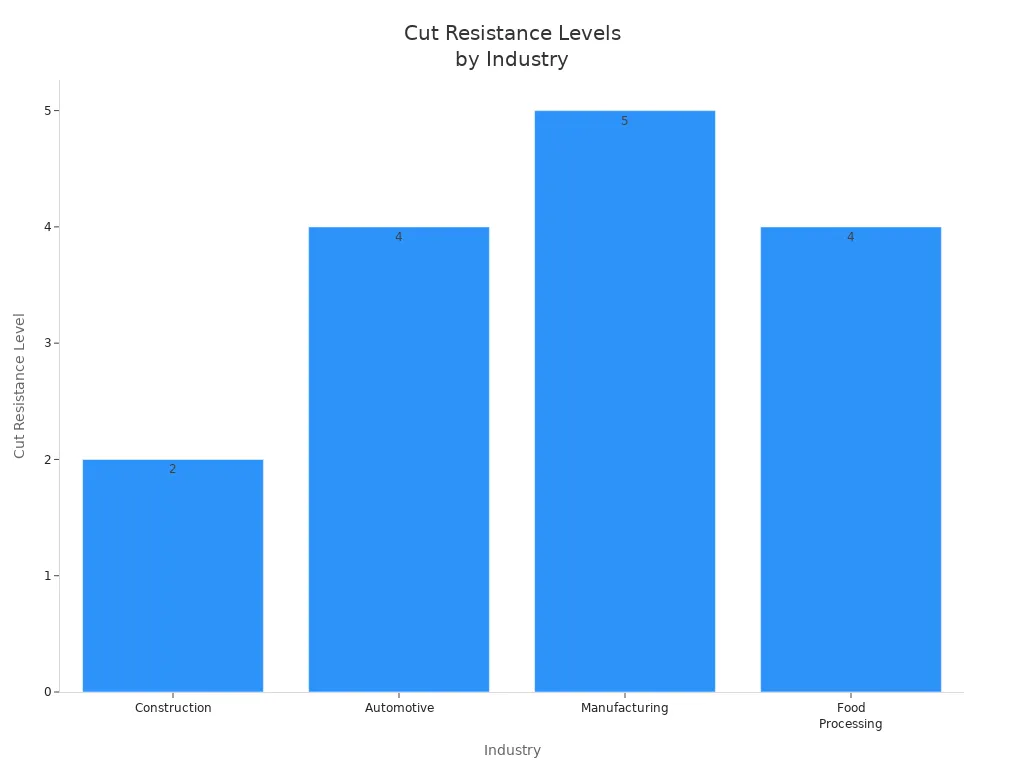
These ranges are starting points, not rules. The hazard on your floor decides the final specification, and the only reliable way to confirm it is a task observation.
Manufacturing and Metal Fabrication
Blade handling, sheet metal edges and stamping work typically call for A4 to A6 on either scale. Where operators handle freshly cut sheet metal, the hazard is a clean sharp edge, and cut level is the dominant requirement. Where they also handle oily parts, add a sandy nitrile coating for grip.
Construction and Demolition
Construction combines cut hazards with impact and puncture hazards, so a single cut rating is rarely the whole specification. A4 and above is the usual range, with TPR impact protection on the back of the hand and reinforced palms for rough material handling. See our heat-resistant gloves range where welding or hot work is also present.
Food Processing
Food processing adds a regulatory layer that cut rating does not address. Beyond A2 to A4 for typical knife and filleting work, gloves need a food-contact-suitable coating, documented traceability, and visibility of the material declaration. Metal-detectable fibres are often specified so that a broken fibre is caught downstream.
Automotive and Mechanical Assembly
Assembly work weights dexterity above absolute cut level. A3 to A5 with a thin foam nitrile coating and a light gauge keeps tactile feel high, which matters when handling clips, connectors and trim. Where the task involves oil and coolant exposure, chemical resistance becomes a co-equal requirement - our guide to how nitrile chemical-resistant gloves work covers that side of the selection.
Common Myths About Cut-Resistant Gloves
Four misconceptions come up repeatedly in procurement conversations, and each one leads to a specific type of mistake.
- "Higher is always safer." A glove rated higher than the task requires is heavier and less dexterous, so workers remove it. A glove that is worn but rated A4 beats a glove rated A6 that stays in the toolbox.
- "Cut-resistant means cut-proof." No glove is cut-proof. The rating describes performance against a defined test, not immunity. Serrated edges, needles and powered blades fall outside what the test measures.
- "All gloves of the same rating perform the same." They do not. Gauge, coating and fibre blend differ between manufacturers, which changes weight, dexterity and how the glove holds up over its life. Two A4 gloves can feel completely different on the hand.
- "One size works for everyone." Ill-fitting gloves cause both discomfort and injury - a loose glove slips and a tight one restricts circulation and reduces grip. Sizing samples are worth the delay.
Worth adding: nitrile is widely described as allergy-free, but it is more accurate to say it has a much lower sensitisation rate than natural rubber latex. Workers with a known latex allergy should still trial nitrile before a full rollout.
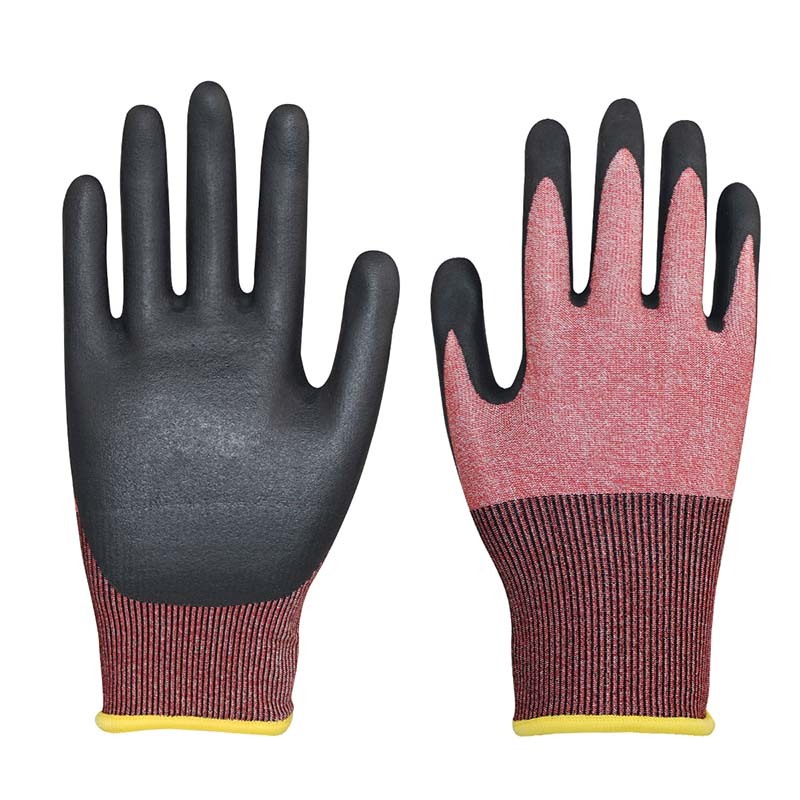
CR1025 18G Foam Nitrile Cut Resistant Gloves
- Thin 18-gauge HPPE shell for high dexterity on fine assembly
- Foam nitrile palm coating for a light, clean grip on dry parts
- Knitted cuff with a snug fit that keeps debris out during inspection work
What to Verify Before You Order
Five checks, all of which can be done on paper before anything ships.
- Which standard? The quote must name EN388 or ANSI/ISEA 105. If it shows a bare letter or number without a system, ask before ordering.
- What is the certificate number? Ask for the test report number for the specific glove, not a logo on a brochure. A report number can be verified; a logo cannot.
- What gauge and coating? These determine dexterity and grip, and they are frequently omitted from quotes that focus on cut level alone.
- Has the cut level been tested on this exact construction? The rating applies to the finished glove, not to the yarn. Confirm the report matches the model, coating and gauge you are buying.
- Do you have a sizing sample set? Order samples and let the actual crew trial them before committing to a production quantity.
Frequently Asked Questions
What is the difference between EN388 and ANSI cut ratings?
They are separate standards using different blades, loads and procedures. EN388 runs A to F; ANSI/ISEA 105 runs A1 to A9. There is no reliable conversion between them, so a quote must state which system it uses.
What cut level do I need for sheet metal handling?
A4 to A6 is the usual range for handling clean, sharp sheet edges. Where the metal is rough-edged, stamped or punched, add impact protection and reinforce the palm, because the hazard is no longer only cutting.
Are cut-resistant gloves required to be food-safe?
Only where the glove contacts food. In food processing, look for a food-contact-suitable coating, a material declaration and traceability, in addition to the cut rating. Metal-detectable fibres are often specified as well.
Does the coating affect cut resistance?
Very little. The coating is there for grip and abrasion. Cut resistance comes from the liner and the knit. A heavily coated glove with a weak liner will still fail at its rating.
How often should cut-resistant gloves be replaced?
On a schedule, not on failure. Wear shows first at the fingertips and palm. Most operations replace on a fixed interval based on task severity rather than waiting for visible damage.
Can I use one glove type across all departments?
Rarely a good idea. Cut level, gauge and coating trade off against each other, so the right specification differs by task. Consolidating usually means over-specifying in one area and under-specifying in another.
Selecting cut-resistant work gloves comes down to three decisions in order: which rating system you are specifying in, what level the hazard actually requires, and what material, coating and gauge will keep the glove on the hand. Get those three right and the rest follows.
Before your next order, ask for the standard, the certificate number, the gauge and the coating, and trial a sizing sample set with the crew who will wear them. Those four items cost nothing and prevent the most expensive glove mistakes - which are almost never about the unit price.
About This Guide
This guide is written for safety managers, procurement teams and distributors specifying cut-resistant hand protection. Rating ranges are starting points based on typical hazards and should be confirmed against a task observation on your own floor. Performance figures quoted here refer to the test procedures described; always verify the certificate for the specific glove model and construction you are buying.
Sources and References
- PubMed Central - review of hand injury burden and glove effectiveness (peer-reviewed evidence on the share of hand injuries involving cuts and lacerations).
- EHS Today - study on glove use and occupational hand injury risk (industry reporting on measured injury reduction from glove programmes).
0users like this.